

Sustainability & Performance
MicroCLT is manufactured from timber sourced through PEFC-certified supply chains, ensuring that raw material procurement meets internationally recognised standards for responsible forestry management.
As a solid timber panel, MicroCLT stores biogenic carbon throughout its service life. When specified in place of concrete, steel, or composite panel systems, it contributes to reducing a project’s embodied carbon footprint—a factor of increasing importance within green building frameworks.
PEFC-Certified
- Timber sourced from responsibly managed forests
- Meets international standards for environmental and social responsibility
- Full chain of custody—traceable from forest to finished panel
- Certification documentation available on request
Responsibly Sourced.
Naturally Built.
- Solid timber construction—no veneers, no composites
- Stores carbon throughout its service life
- Naturally degradable at end of life
- Verifiable sourcing. Full documentation available on request.
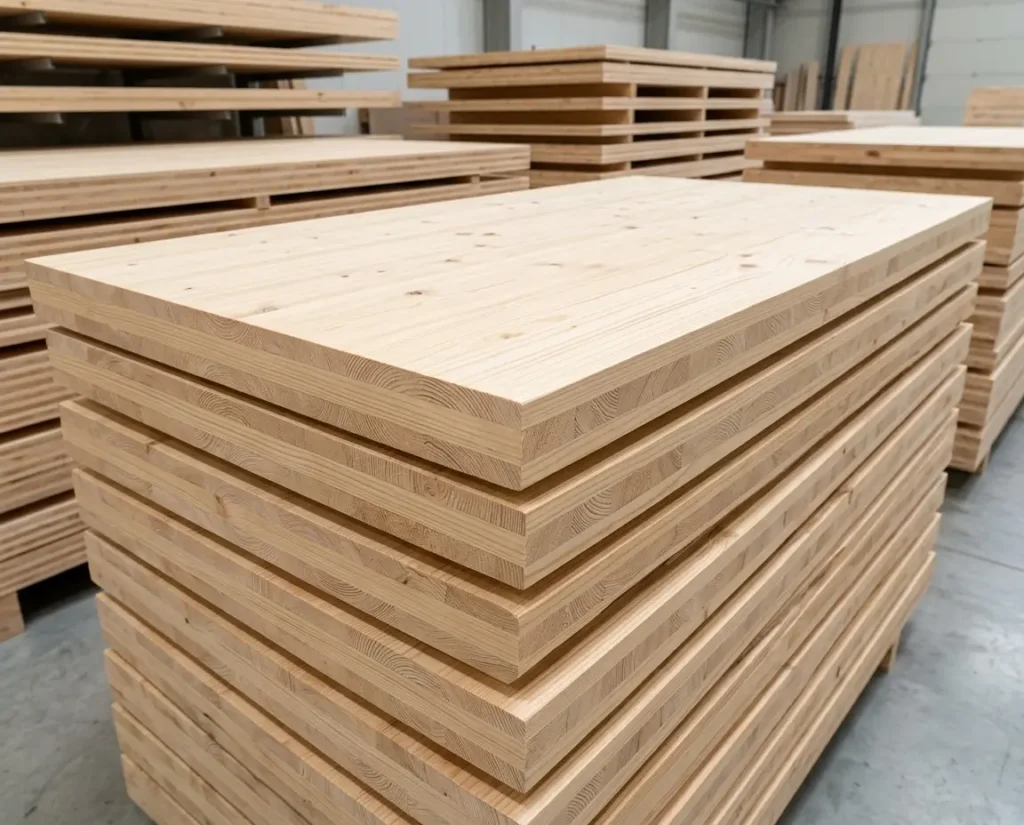
Acoustic Comfort
The cross-laminated construction of MicroCLT improves acoustic damping relative to solid timber panels. The alternating grain layers interrupt vibration transmission paths, reducing both airborne and structure-borne sound transfer.
For applications requiring higher acoustic performance, MicroCLT can be combined with insulation layers, gypsum board assemblies, or specified in thicker panel formats.
Sound Insulation Comparison — Interior Applications
| Material | Typical STC Range* | Relative Performance | Key Notes |
|---|---|---|---|
| Concrete Wall / Slab (150 mm) | ~50–55 | Very Good | High mass provides strong sound blocking |
| Gypsum Board Partition (double layer with insulation) | ~45–55 | Good | Common interior acoustic system |
| Concrete Masonry Block (CMU) | ~44–50 | Good | Performance depends on cavity insulation |
| MicroCLT (with insulation assembly) | ~45–50 | Good | Cross-lamination reduces vibration; achieves higher performance when combined with insulation or gypsum |
| MicroCLT (panel only) | ~35–40 | Medium | Based on laboratory testing of comparable CLT panels; suitable for standard interior applications |
| Solid Wood / Plywood / Thermowood | ~25–35 | Low–Medium | Lower mass; transmits sound easily |
| Glass (single pane) | ~25–30 | Low | High sound transmission unless laminated or double glazed |
* STC = Sound Transmission Class. Higher values indicate better sound isolation.
Where Craft Meets Safety.
Our Fire Performance.
MicroCLT achieves a B-s1, d0 reaction-to-fire classification under European Standard EN 13501-1—a high-performance safety standard for timber-based materials. This rating evaluates three independent performance criteria:
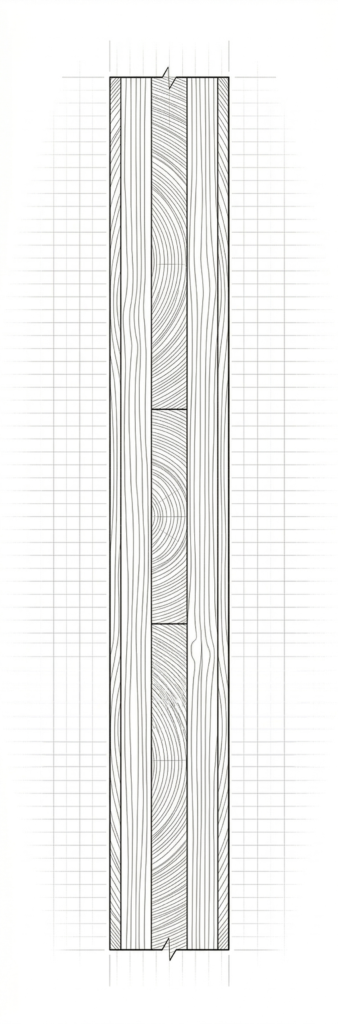
B — Combustibility Behaviour
The B rating indicates that the material contributes very little to fire spread. It burns slowly, propagates flame minimally, and does not significantly accelerate fire development. This behaviour allows adequate time for evacuation and the implementation of firefighting measures.
s1 — Smoke Production
The s1 designation confirms low smoke output during combustion. The material does not meaningfully reduce visibility or generate toxic gases that could impede evacuation or cause inhalation injury — a critical criterion in high-occupancy buildings.
d0 — Flaming Droplets
The d0 classification confirms the complete absence of flaming droplets or particles during fire conditions. This eliminates the risk of secondary ignition from falling particulates, contributing to a safer fire environment.
Classification Context
In the EN 13501-1 hierarchy, B-s1, d0 positions MicroCLT above Category C and D materials in terms of fire safety. While A2-s1, d0 offers greater fire resistance, it is reserved for inorganic or near-non-combustible materials and is not applicable to wood-based products.
Test documentation available on request.