For decades, interior architects have lived with a quiet compromise. The materials we specify for walls, ceilings, doors, and joinery are rarely the materials we actually want. We choose MDF for its workability and price, but accept that it is a composite of glue and dust. We pick plywood for its strength, but contend with edge grain that has to be hidden. We reach for veneered panels when we want the look of timber, knowing the surface is a fraction of a millimetre thick — a photograph, more than a material.
Conventional Cross-Laminated Timber, or CLT, has long offered an alternative philosophy: solid wood, engineered for stability, used as a structural element. But conventional CLT was never built for interiors. The panels are thick, heavy, and dimensioned for buildings, not for the kind of detail-driven joinery that defines hospitality, residential, and retail fit-out. MicroCLT was developed to close that gap.
A new category of panel
MicroCLT is an engineered timber panel that brings the structural intelligence of cross-laminated construction into a slimmer, more versatile format suited to interior architecture. Cross-laminated layers of high-quality timber are bonded with their grain directions alternating, producing a panel that is dimensionally stable, structurally robust, and surfaced in genuine solid wood. It is not a composite faced with a veneer. It is not a plywood substitute. It is solid timber, engineered.
Why the construction matters
The properties that make MicroCLT distinctive all come from the way it is built. The cross-laminated structure means that when humidity rises or falls, the layers restrain one another — minimising the expansion and contraction that plagues solid timber and large-format panels. This is what allows MicroCLT to hold its shape across a five-metre run, a tall door, a flush wall panel. Where a single board would warp or split, a cross-laminated panel sits flat.
The alternating grain also produces exceptional screw-holding. Fasteners engage with solid wood fibres across multiple axes, rather than crumbling into the binder of a composite. For joiners specifying hinges, runners, handles, and structural connections, this means hardware that stays seated for the life of the installation. The face layer is solid timber — not a 0.6 mm veneer over a substrate. The grain you see is real, deep, and continuous with the panel itself. It can be sanded, refinished, repaired, and aged in a way that veneered surfaces simply cannot.
The format that changes the design language
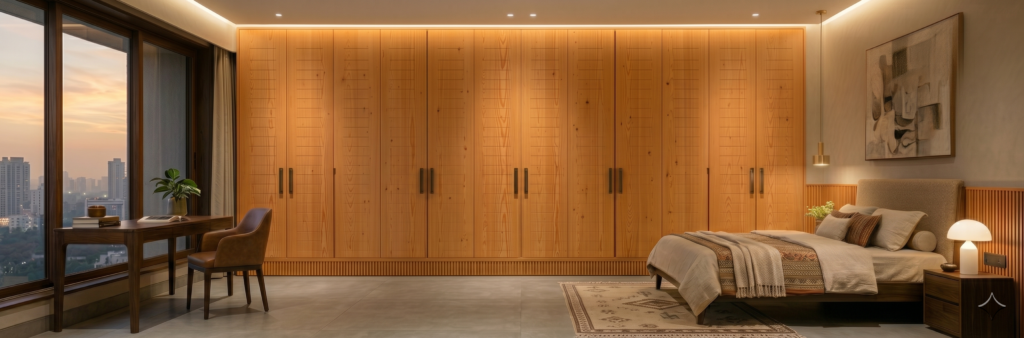
Perhaps the most significant property of MicroCLT, from a designer’s perspective, is the panel size. At up to 5,000 × 2,050 mm, a single sheet can clad a full-height wall, a long ceiling run, or a floor-to-ceiling wardrobe without a visible join.
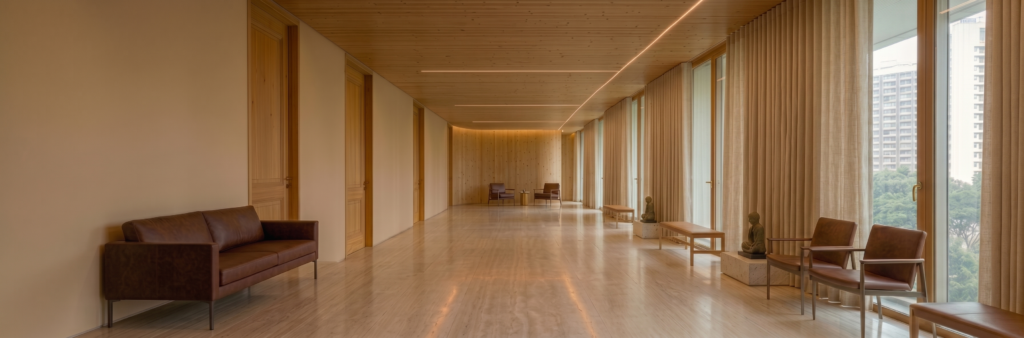
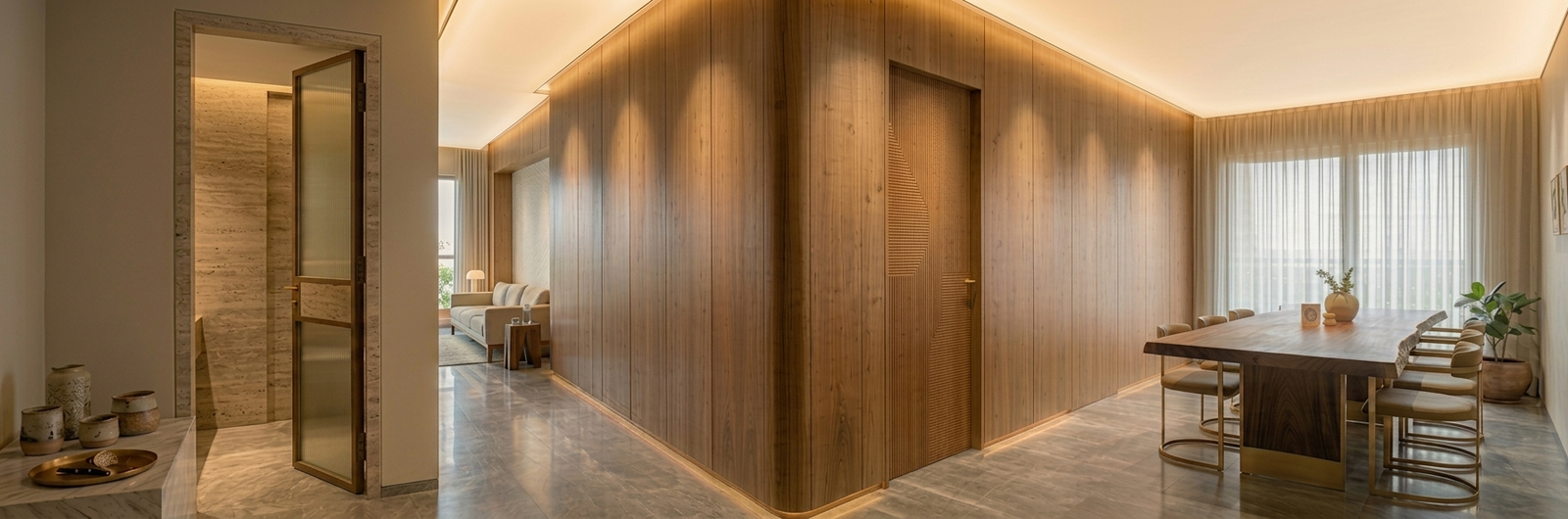
This sounds like a small thing. It is not. Most interior detail languages are organised around the joint — because the joint is where a smaller board ends. When you can eliminate the joint, you eliminate the need to detail it, frame it, mask it, or design around it. The surface becomes monolithic. The eye reads the material, not the breaks in it. For hospitality interiors, where wall and ceiling planes are central to the guest experience, this matters more than almost any other property. A continuous timber wall in a villa or boutique hotel reads as craft, not as cladding.
Built for modern joinery workflows
MicroCLT is designed to integrate with the way contemporary joinery is actually produced. It is fully compatible with CNC routing, profiling, and edge detailing — machining cleanly and predictably, without the tear-out and inconsistency that solid timber can introduce, and without the dust signature of MDF. This means bespoke patterns, fluted detailing, repetitive geometric routing, and complex architectural profiles can be cut accurately and repeatedly. For studios working on highly detailed, made-to-measure interiors, the panel behaves the way a designer wants it to — predictably, finely, at scale.
The surface accepts stains, oils, lacquers, and pigments. The same panel can be specified raw for a Scandinavian-leaning villa, deep-stained for a darker boutique hotel scheme, or pigmented for a more graphic, contemporary interior. The material does not impose a single aesthetic; it supports the one the designer intends.
A sustainability story that holds up under scrutiny
Sustainability claims in materials are often softer than they appear. MicroCLT’s environmental credentials sit on firmer ground. The timber is sourced from responsibly managed forestry certified under PEFC standards. As a wood-based product, it stores biogenic carbon for the life of the installation, locking atmospheric CO₂ into the building. Its embodied carbon footprint is materially lower than concrete, steel, or composite panel alternatives.
For specifiers increasingly being asked to defend their material choices in tenders, ESG reports, or guest-facing communications, MicroCLT offers a panel that performs well across both technical and environmental criteria.
Where it fits
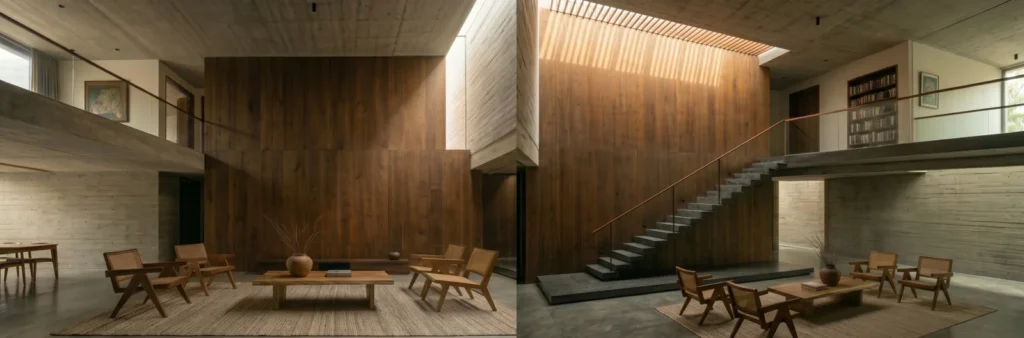
MicroCLT is suited to applications where interior architecture matters: full-height wall panelling, ceiling installations, doors and door fronts, wardrobe and cabinetry shutters, bespoke joinery, retail fit-out, and high-spec residential interiors. It is particularly well suited to hospitality projects, where the difference between specified-down materials and specified-up materials is felt directly by the guest.
A material that stops compromising
The story of interior materials over the last fifty years has largely been a story of substitutes — composites that simulate solid wood, veneers that imitate it, finishes that approximate it. MicroCLT was developed for the studios and operators who want the real material, in formats and tolerances that work for contemporary design and construction. It is solid timber, engineered for interiors. We are excited to see what you build with it.