The joint as design language
When you cannot avoid joints, you design with them. This is why so much contemporary interior detailing organises itself around vertical and horizontal lines spaced at predictable intervals — board widths, panel modules, expressed seams. Sometimes those joints become the design: shadow gaps, reveal lines, deliberate breaks that turn a constraint into a rhythm. Sometimes they are concealed with cover strips, in-fills, or colour-matched filler, asking the eye to ignore what the surface plainly shows.
Either way, the joint is doing work. It is adding labour to fabrication. It is adding installation time on site. It is creating a junction that has to be detailed, sealed, finished, and ultimately maintained. It is, more often than not, a compromise made because the material would not behave any other way.
Removing the constraint
MicroCLT panels are produced at up to 5,000 × 2,050 mm. That single dimensional shift carries consequences across the entire interior architecture toolkit.
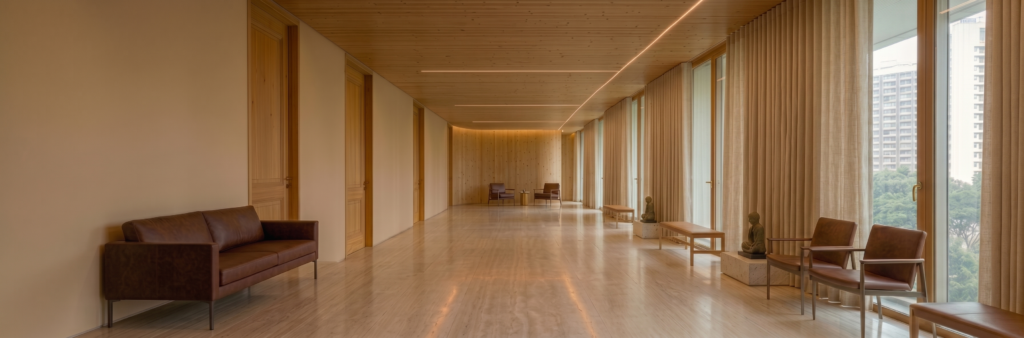
A standard residential ceiling height of 2.4 metres can be clad in a single panel, full-height, with no horizontal joint. A villa or boutique hotel with three-metre ceilings can run a wall in a single sheet over two metres wide — well beyond the width of a conventional panel. A wardrobe shutter can rise from floor to ceiling without an applied break or hidden seam. A long corridor ceiling can read as a single, continuous timber plane. The 8-foot rule is not so much broken as made irrelevant.
What changes when the joint disappears
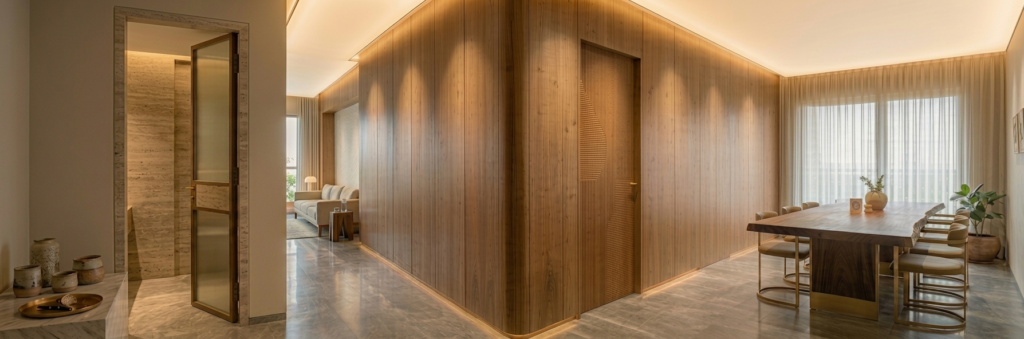
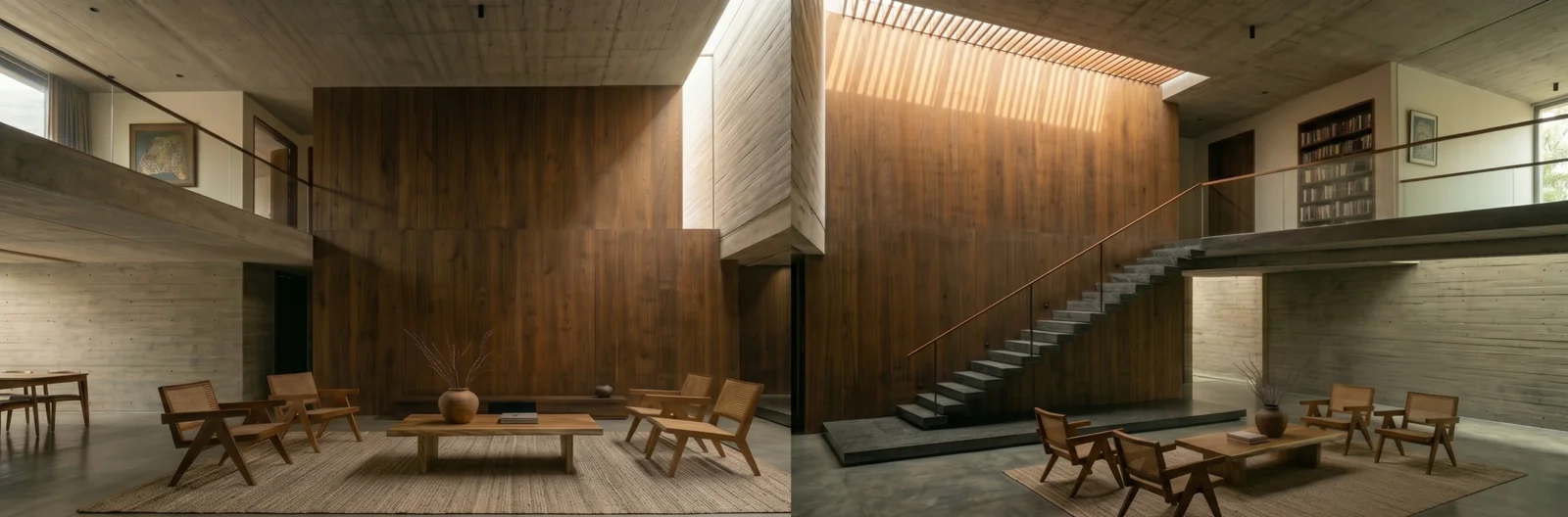
When the surface becomes monolithic, the way the eye reads the material changes. A wall composed of seven panels reads as panelling. The same wall in a single sheet reads as material. The mind classifies it differently. It feels intentional in a way that a clad surface does not.
Detail languages also simplify. There is no longer a need to design a board-edge condition, no longer a need to specify a shadow gap or a butt joint or a coverstrip. The surface meets the floor, the ceiling, and the adjacent walls — and that is it. The visual energy that was once consumed by the rhythm of joints is freed up for the things that actually want to be seen: the texture of the timber, the proportion of an opening, the geometry of a piece of furniture against the wall. Installation also changes. Fewer panels mean fewer interfaces, less alignment work, less filler, less finishing. A room that might have taken three days to clad in conventional sheet material can often be installed in a single day in MicroCLT. The reduction in labour is real — and it tends to translate directly into either margin or quality, depending on how the project is run.
Doors, walls, ceilings, wardrobes
The applications where the large format pays off most directly are the ones where joints have always been the most awkward. Internal doors are an obvious example. A flush 2.4-metre door in conventional materials almost always has either a face joint, a perimeter band, or an applied edge. In MicroCLT, the same door can be produced as a single solid timber face — flush, dimensionally stable, and, because of the cross-laminated construction, less prone to twisting or warping over time.
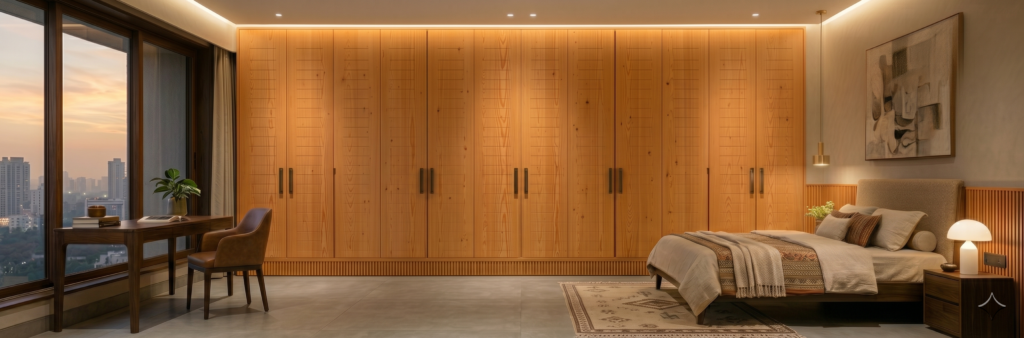
Wardrobe shutters tell a similar story. Tall, full-height shutters demand both visual continuity and dimensional stability — and in conventional materials, you usually get one but not both. The MicroCLT format produces shutters that read as monolithic and stay flat through seasonal humidity changes. Ceilings benefit perhaps most of all, because the eye is unforgiving of horizontal joints overhead. A continuous timber ceiling above a dining area, a lobby, or a bedroom transforms the volume into something that feels carved rather than constructed.
Why this matters in hospitality
In hospitality interiors, the surfaces a guest touches and looks at carry disproportionate weight. A guest may not consciously register that a wall has no joints, that a ceiling runs uninterrupted, that a door is solid timber to its edges. They will, however, register that the room feels considered. They will sense, without articulating it, that something in the materiality of the space is unusual.
That feeling is the difference between a villa or boutique hotel that reads as well-finished and one that reads as crafted. It influences how guests photograph the space, how they describe it in reviews, how they remember it. For operators competing on experience rather than price, it is a meaningful lever.
The format is the feature
It is tempting to describe MicroCLT in terms of its technical properties — its dimensional stability, its screw-holding, its sustainability. All of those matter. But the format itself is also, in its own right, a feature. It changes what designers can draw, what joiners can build, and what guests experience.
The 8-foot rule has shaped interior architecture for decades. It does not have to shape yours.