Dimensional stability
MDF is dimensionally stable in dry conditions but vulnerable to moisture. Once water enters, the fibres swell and the panel does not return to its original form. In bathrooms, kitchens, and humid coastal environments, this is a real consideration. Plywood is more resilient than MDF but still subject to seasonal movement, particularly in larger formats. The veneers within the panel can also delaminate over time if subject to repeated humidity cycles.
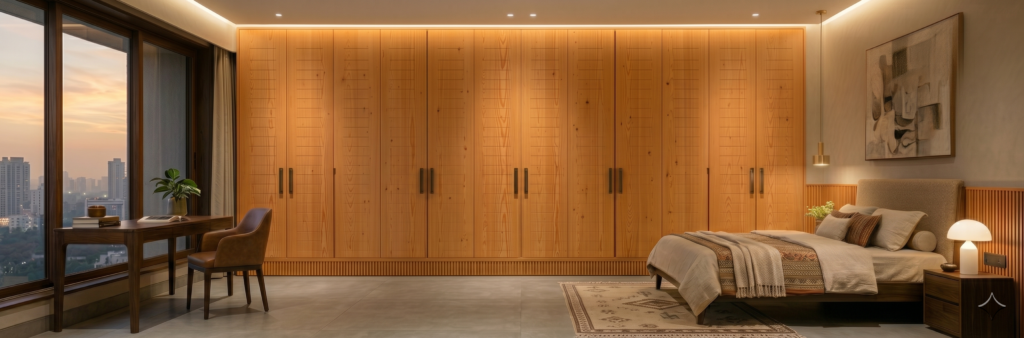
Veneered composite panels inherit the stability of their substrate — usually MDF or plywood — and add a paper-thin face that can crack or lift if the substrate moves significantly. MicroCLT’s cross-laminated construction restrains movement across both axes. The alternating grain layers act against one another, holding the panel flat through humidity changes that would distort solid timber. This is what makes it credible at 5,000 mm runs and in tight-tolerance applications like flush doors and wardrobe shutters.
Screw-holding and fixings
This is where the differences become operational. MDF holds screws adequately on first installation, but threads degrade quickly under repeated insertion or load. Hinges and runners on heavily used doors and drawers tend to loosen over the lifetime of a fit-out.
Plywood holds screws better than MDF, particularly when fixed into face grain rather than edge. Edge-grain fixings in plywood are notoriously unreliable. MicroCLT’s cross-laminated construction means screws engage with solid timber fibres across multiple axes, regardless of where the fixing enters the panel. The result is screw-holding capacity that materially exceeds composite alternatives — particularly meaningful for hardware-heavy applications like wardrobes, doors, and structural joinery.
CNC machining
MDF machines very cleanly — it is, in fact, the easiest of these materials to CNC. But the dust signature is significant, and the cut surfaces require sealing before finishing. Plywood machines well on faces but reveals layered edges that have to be filled, edged, or designed around.
MicroCLT machines cleanly and predictably. Its solid timber composition produces a finished edge that does not require concealment. CNC-routed details — fluting, profiling, geometric patterns — can be left exposed as a feature rather than as a problem to solve. For studios that rely on bespoke routing and patterning as part of their design language, this is a meaningful workflow advantage.
Surface authenticity
This is the dimension where the gap is widest. Veneered panels offer the appearance of timber, but the face is typically 0.6 mm thick. Sanding, refinishing, or repairing a damaged veneer is risky and often impossible without replacement. The grain is real, but it is also a thin photograph laid over a substrate.
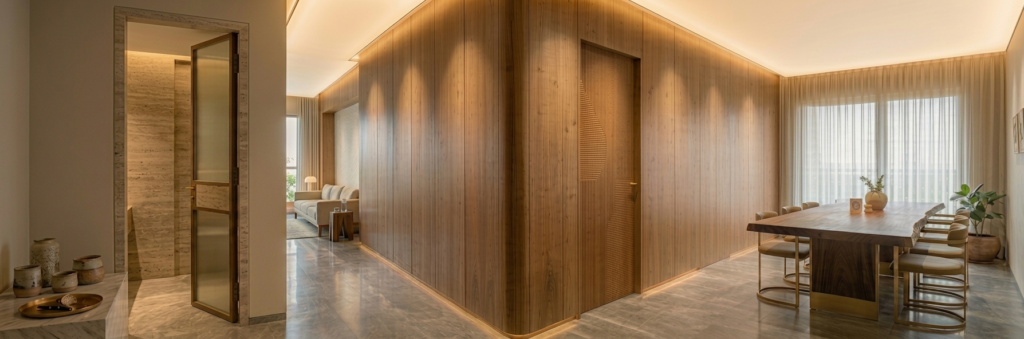
MDF and plywood, when used unfaced, do not offer a timber appearance at all. MicroCLT’s face is solid timber — not a veneer, not a film, not a print. The surface can be sanded, refinished, or locally repaired without exposing a different substrate underneath. It accepts stains, oils, lacquers, and pigments, and the grain reads as deep, consistent, and authentic across the panel. For interiors where the material is meant to be read — hospitality, high-end residential, signature retail — this is often the deciding factor.
Lifecycle and longevity
MDF has a defined lifetime, particularly in environments with any humidity exposure. Repeated cycles of moisture eventually compromise the panel. Plywood is more durable but rarely refinishable in a meaningful sense; once the face is damaged or worn, replacement is usually the only option.
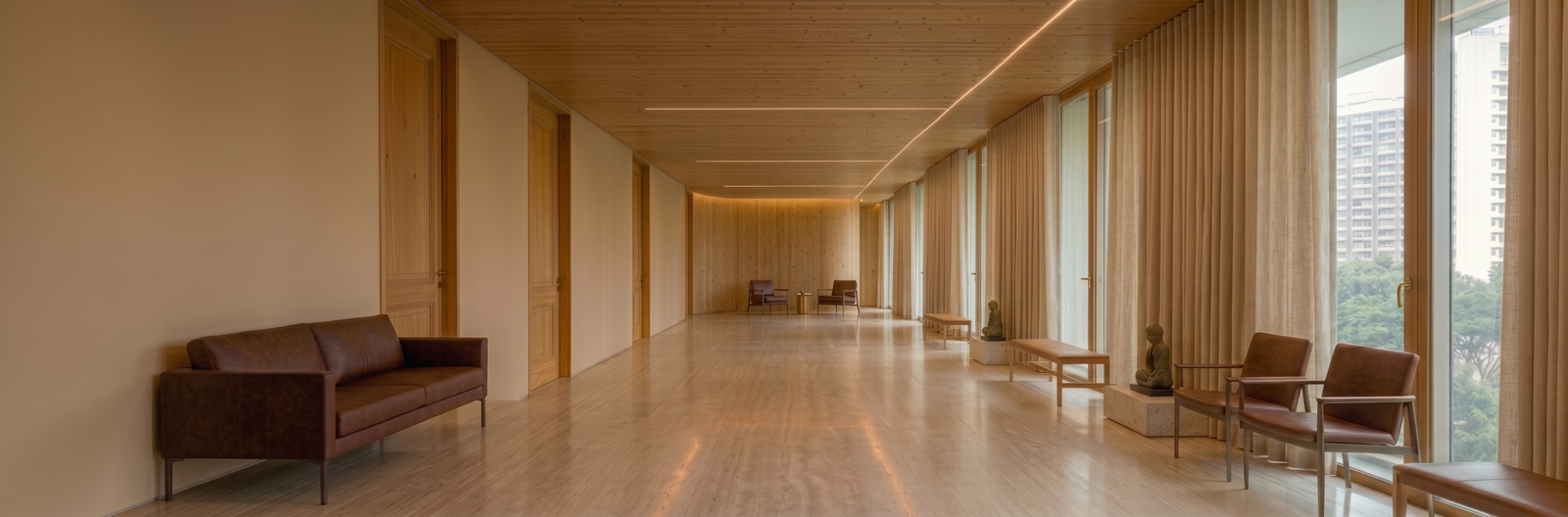
Veneered panels are limited by the thickness of their face layer. A scratch or knock that penetrates the veneer reveals the substrate beneath, and the entire panel typically has to be replaced. MicroCLT, like the solid timber it is, can be sanded, refinished, and rejuvenated multiple times across its lifetime. A door, a wardrobe shutter, or a wall panel installed in MicroCLT can be expected to age gracefully and be restored, rather than replaced, when wear becomes visible. For projects designed to last, this is a fundamental shift in lifecycle economics.
Where each material still belongs
This is not an argument that MicroCLT replaces every panel material. It does not. MDF remains a sensible choice for painted joinery, low-spec applications, and concealed structural elements. Plywood remains the right answer where its combination of strength, weight, and price is unbeaten — particularly in concealed substructures and utilitarian applications. Veneered panels remain useful where a specific exotic species is required at a price point that solid timber cannot reach.
What MicroCLT changes is the calculation for everything in between — the visible joinery, the doors, the wardrobes, the wall and ceiling panels, the bespoke architectural detailing where the surface is meant to be experienced as material rather than as cladding.
Writing it into a spec
For specifiers, the practical question is where MicroCLT belongs in the materials schedule. The honest answer is: anywhere the surface matters and longevity is part of the brief. It is not the cheapest panel on the page, but the lifecycle, surface authenticity, and machining behaviour change the value calculation in its favour for high-spec interiors.
The right comparison is not panel-to-panel cost. It is the cost of a finished, installed, serviceable surface — over the life of the building. By that measure, MicroCLT changes the spec.