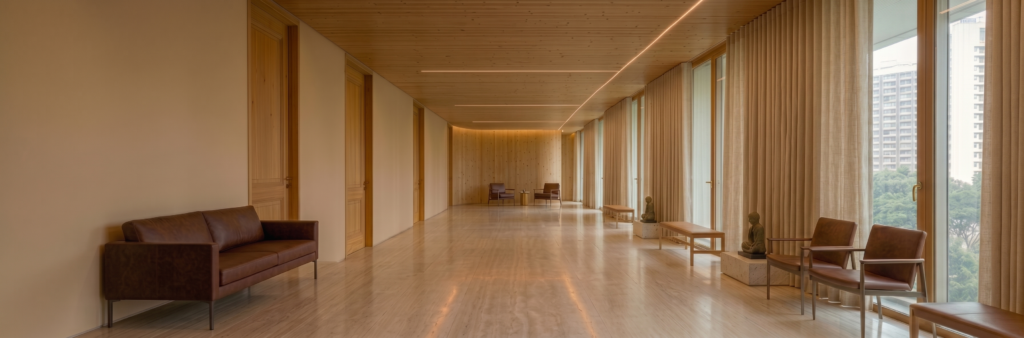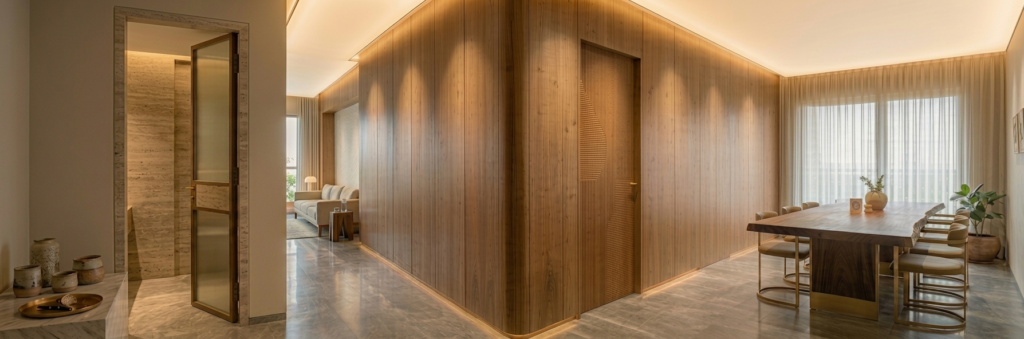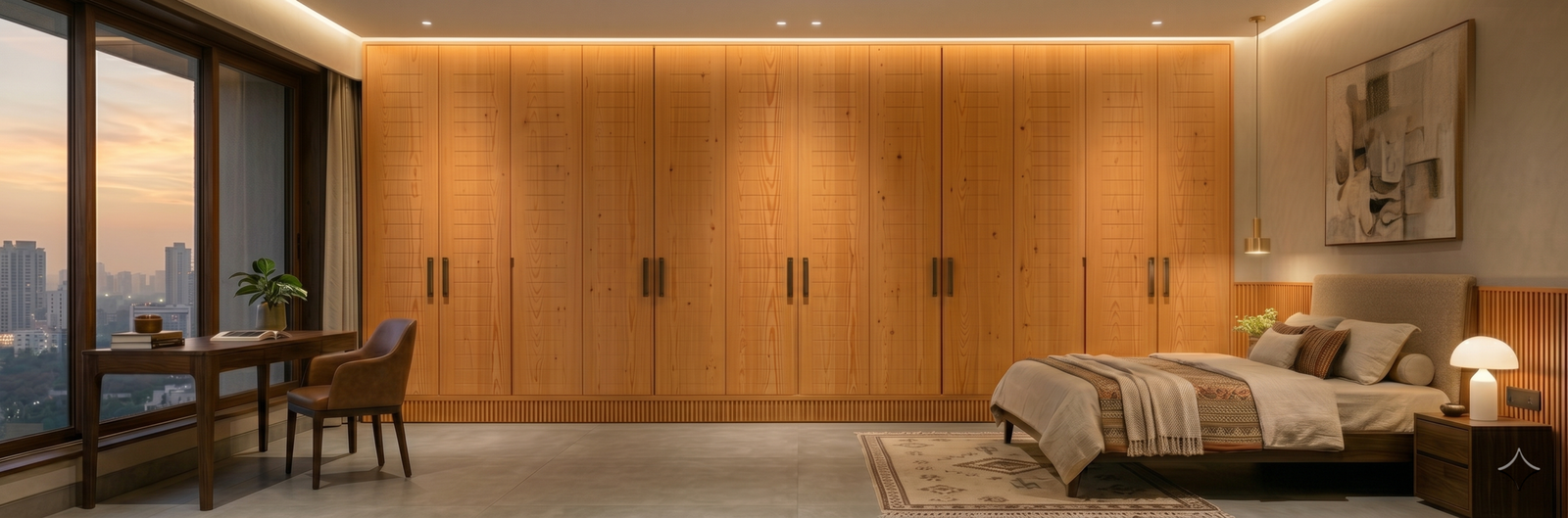
The fit-out cycle
A commercial interior is typically refurbished every seven to ten years. A hospitality interior — particularly one operating in a competitive segment where guest expectations evolve quickly — is often refurbished more frequently than that. A high-spec residential interior may sit untouched for fifteen years, but the joinery, doors, and panelling within it tend to outlast the design language they were specified into. They are replaced not because they have failed, but because the room has changed. Across a fifty-year building lifecycle, a single structure may carry three, four, or five generations of interior fit-out. Each generation has its own embodied carbon — its own walls, ceilings, doors, joinery, panels, and finishes — and each generation contributes to the building’s cumulative footprint.
This is the part of the carbon conversation that does not yet have the same volume as the structural one. And it is the part where specifiers, designers, and operators have the most direct influence.
The materials that fill our interiors
If you audit the panel materials behind a typical contemporary interior, you will find a fairly predictable list. MDF for painted joinery and concealed substrates. Plywood for structural elements within cabinetry and wall build-ups. Veneered MDF or plywood for exposed faces. Composite panels with HPL or melamine surfaces for higher-traffic applications. Some solid timber, increasingly, for accent surfaces.
Each of these materials carries an embodied carbon figure that reflects its production. MDF is produced from wood fibres, but its manufacture is energy-intensive and binder-heavy. Composite panels with synthetic surfaces inherit the carbon of both their substrate and their facing. Aluminium and steel-framed elements within interiors carry the high embodied carbon of their primary metals. The numbers are not catastrophic per panel. They are, however, multiplied by the area of every wall, ceiling, door, and shutter in the building — and by the number of fit-out cycles that pass through it.
The biogenic carbon advantage
Timber is unusual among construction materials because it does not just have a low embodied carbon figure — it has a negative one, at least at the moment of harvest. As trees grow, they absorb carbon dioxide from the atmosphere and incorporate it into their structure. When that timber is used in a building, the carbon is locked into the material for as long as the installation lasts. This is biogenic carbon storage. It is not theoretical: it is measurable, and it is meaningful at the scale of a building’s interior. MicroCLT, as a cross-laminated solid timber panel, stores biogenic carbon for the life of the installation. Where a square metre of MDF panelling contributes a positive embodied carbon figure to the building, the equivalent square metre of MicroCLT contributes a stored carbon figure — atmospheric CO₂ that has been removed from the air and held within the panel.
When that calculation is run across the full interior surface area of a hospitality project — the wall panels, the ceiling planes, the doors, the wardrobe fronts, the bespoke joinery — the difference is no longer marginal.
Responsible sourcing matters
Biogenic carbon storage is only as credible as the forestry behind it. Timber harvested from poorly managed forests, or from forests that are not regenerating at the rate of harvest, does not deliver the carbon benefit it claims. MicroCLT is sourced from forestry certified under PEFC standards — the Programme for the Endorsement of Forest Certification — which audits forest management against criteria including biodiversity, regeneration, and the rights of communities dependent on the forest. PEFC certification is not the only forestry standard in the world, but it is one of the most widely recognised, and it provides specifiers with a defensible answer when clients ask where the timber came from.
For projects working towards BREEAM, LEED, or other environmental assessment frameworks, certified timber is also a contributor to credits within the materials category. Specifying MicroCLT does not just improve the building’s carbon position — it tends to improve its assessed performance as well.
The specifier’s role
Sustainability in interiors is unusual in that the specifier — the architect, the interior designer, the procurement lead — has unusually direct influence over the outcome. The choice of panel material is made early, encoded in a specification document, and carried through to installation. There is no further dilution between the decision and the result. This means that the carbon position of an interior fit-out is, to a meaningful extent, a design decision. Specifying MicroCLT in place of MDF, veneered composite, or laminate panels for the visible surfaces of an interior is one of the highest-leverage carbon decisions a designer can make within their direct control.
It is also a decision that does not require the client to make a sacrifice. The specifier is not asking the project to accept a lesser surface in exchange for a better carbon outcome. They are specifying a panel that performs better technically, looks more authentic, lasts longer, and stores carbon — at a price point that competes for the visible-surface portion of a high-spec interior.
The story worth telling
The structural carbon conversation has dominated sustainability discourse in construction for good reason. But the interior is the part of the building that we touch, see, and replace — and it is where designers and specifiers have the most concentrated ability to influence the carbon outcome.
MicroCLT was developed to give that decision a credible, defensible, and beautiful answer. The hidden carbon story in your interiors does not have to stay hidden.